Tuesday, May 10, 2016

Warm Welcome in El Salvador

Tide and time brought us to El Salvador unexpectedly, but it turned out to be a welcome respite once we got the arrangements made. We turned from our course SE and instead sailed northward towards Bahia Jiquillisco located 70 miles NW of our intended destination of Puesta del Sol in Nicaragua.

This marina is located 9 miles up an estuary whose entrance is ringed by breakers and shoals.


Our navigation guide warned that a pilot boat is a necessity rather than an option, so it was imperative to the safety of our boat that we contact the marina for a guide. For hours I called, trying to reach the marina by SSB and VHF radio with no success. Our cell phone had no service and our Inmarsat satellite phone gave me the annoying British voiced message, "Your balance is below the limit, please top off your account." before disconnecting my call. This was especially frustrating since we had loaded $300 in airtime onto the phone just a few months prior and had not used it, saving the phone for emergency use only. Turns out that Inmarsat charges $15 per week for the privilege of owning the satellite phone, so all of our money was taken by their fees. I hope anyone reading this will decline to use the services of this company, as I certainly wish we had decided to do when we first purchased the boat!

Running out of options and daylight, we eventually reached the US Coast Guard via the satellite phone, the only number that still worked on the unit. I explained our situation, provided our location and the phone number for the marina, and they were more than helpful in making contact with the marina for us. Quickly we were contacted via VHF (turns out the marina had neglected to turn their radios on that day!) and sent a pilot boat and escorted through the breakers and shoaling entrance to the estuary.


Along the way we passed some unusual sights. Buildings made to float and some that were floating but not intended to do so.


Once tied up to a mooring bouy the port officials were brought out to the boat and clearance was a simple matter of filling out a few forms. Everyone was friendly and the fees for the mooring were inexpensive, $45 for the first day, which included the service of the pilot boat, and only $17 for each day thereafter.

Other boats moored at Barillas marina.

Barillas marina is located in the middle of a vast plantation of bananas, sugar cane, and other crops. It is guarded by armed men and sports a small compound for the guests consisting of an office (air conditioned), restaurant, shop, showers and laundry facilities as well as such luxuries as a swimming pool and hammocks strung up amongst the shade trees. The marina has seen better days and the guide book mentioned a travel lift and marine boat yard that no longer exist, but the people are friendly and helpful and the wifi is the best we've had in ages, so no complaints here!


Mooring boys are strung down the estuary next to an old shrimping fleet originally brought down from Texas, now being cut up for scrap.


A neighboring cruiser told us to look closely for a frequent visitor on the top of an overturned and mostly submerged boat just a few hundred yards away. Do you see what I see?


Crocodile rests on the wrecked hull of a fishing boat.
He is estimated to be about 10 ft long. 
Guess we will keep our swimming limited to the pool!
I've since learned that this crocodile has a name...Pana. It means "my buddy" so we hope Pana will be a good neighbor and not try to eat our dinghy.

Hitchhikers on Board


Sailing out of Chiapas after our final inspection and clearance paperwork was completed we set our course SE with the intention of sailing all the way to Nicaragua before stopping. Unfortunately, we met up with headwinds and large swells which slowed us down to a crawl at times, and drenched us with waves over the bow and rain from the scattered squalls at night.

Twice we had hitchhikers join us along the way. A juvenile blue footed boobie was the first to join us, riding along for almost the entire first day before finally flying off when several other of its kind flew past the boat. Only later was I to discover that the name boobie supposedly originated from the Spanish slang for stupid. The bird so named because of it's habit of landing on sailing ships where it was often captured and eaten by the crew. I suppose this one was lucky we were well provisioned!

Our second passenger was a ring necked dove with a light flesh wound on its belly that looked suspiciously like talon marks had made it. Perhaps this dove was the lucky survivor of a falcon's missed meal, heading far out to sea in order to evade it's pursuer. I provided a bowl of fresh water and some bread crumbs and shaved almonds for our guest and it was gladly consumed. Several hours later it departed towards land several miles away.

Two days and two nights later we evaluated the arrival time at our destination and understood there was no way to arrive within the required window of daylight and high tide, necessary for the tricky entrance. So we made the decision to divert northward and enter El Salvador at Bahia Jiquilisco where Barillas Marina is tucked neatly nine miles up the estuary, well protected from the ocean swell and winds. That's the way of sailing...if plan A does not work, make sure you have a plan B and C. So on to El Salvador we went.

Saturday, May 7, 2016

Marina Chiapas

One of the things we notice about moving south along the coast of Mexico is that the marinas tend to become nicer, cleaner, newer, and the staff more helpful. They really seem to appreciate cruisers and go out of their way sometimes to help us get paperwork completed, give a ride into town, or just provide sage advise. This particular marina is one of the finest we have visited along our journey. The manager actually designed and supervised the construction of the marina several years ago, and although it is small, it offers first class service to the sailboats who stop here.


It also features a new 60 ton travel lift and paved storage yard for haul out and dry storage of boats during the off season.


Some of the interesting sea life of the marina included the brown cownose rays that roamed in small schools of a dozen or more around the docks. These are a species of eagle ray ranging in size from palm sized to that of a dinner plate. Feeding on the shells of clams and oysters these rays patrol the shallow waters of the estuary and marina where mollusks are plentiful.


The downside of the marina is the search each boat must go through upon both entry and exit of the marina, including  search with a dog sniffing for drugs? money? We were told that this is because of the proximity of the marina to the border with Guatemala, but we were also told that nothing has ever been found when searching causing sailboats. So why bother? Probably because a naval base is located right next to the marina and just like the US Coast guard, most boardings and searches are simply training exercises for the troops, regardless of any inconvenience to the sailors.


Friday, May 6, 2016

Tope or To Pay?

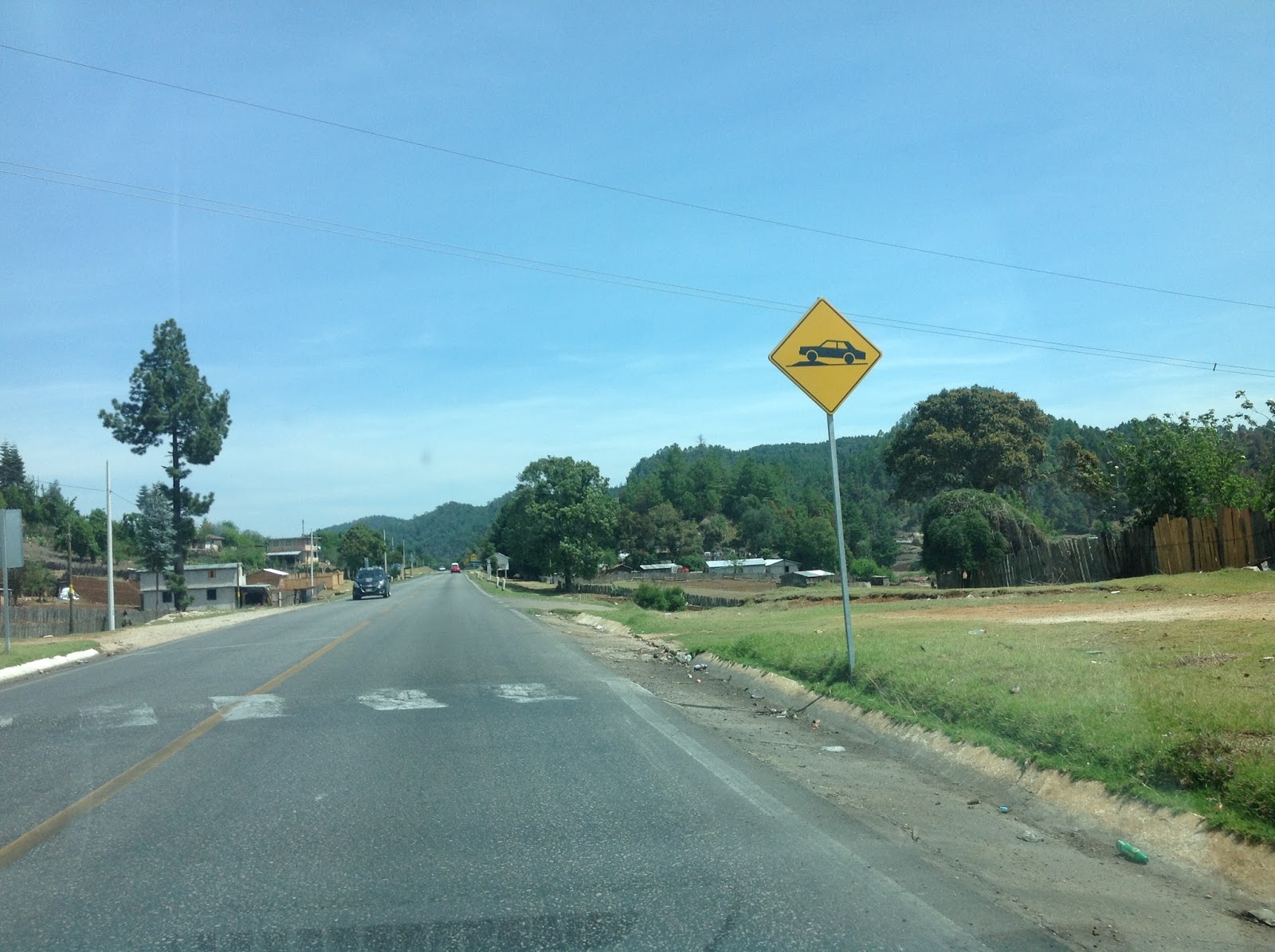
Our inland travel adventure began with a rental car and a loose plan to head North to San Cristobal de las Casas, a colonial city perched in the high pine forests of southern Mexico. We left the cats in the care of another sailor in the marina who was hauling out her boat to put on the hard the day after our departure, so it worked out well for both if us. Our plan was to travel to the city via the mountainous route of backroads which hug the Guatemalan border. Unbeknownst to us that road is not only curvy and rough but also mined with what the locals call TOPEs or speed bumps.  Every time we reached a comfortable speed of 30 MPH or so we would encounter these speed bumps at irregular intervals. Sometimes they were marked, but often hey were not, so both of us had to keep a sharp lookout for them or risk losing the undercarriage of the rental car. Thank goodness we decided to purchase all of the available insurance! After several hours of travel our voyage had become a laughing series of shouts, "TOPE! TOPE!" as we encountered one group of bumps after another.

TOPE - slow down or lose your wheels!

The GPS said it would take us 6 hours to reach San Cristobal, but after 7 hours of driving we realized they had not taken the Topes into account. It was not until much later that we would find out there was a toll road to San Cristobal, a new highway of sorts which looped around on the western side of the mountains. Our return trip on that route took us only 5 hours total and was well worth the toll price! But at the time we were less than half way to our destination and night as fast approaching.

Diverting to a lovely town named Comitan we ended up staying in the same hotel as our friends from S/V Savanna. We enjoyed the lovely town square and cobblestone streets where locals gathered to play music, dine and enjoy the cool mountain weather.  Our meal was excellent, the hotel room was clean and comfortable even lacking air conditioning, but the noise of the cars and local bands kept us up well into the night.

Next morning we were back on the road for another five hours to continue our journey to San Cristobal. Along the curing roads we saw farms and ranches interspaced with Tzotzil and Tzeltal settlements where the indigenous villagers sold fruit along the roadside. Here the native women wore a traditional dress of long haired black goatskin tied at the waist with a wide belt and colorful top. They seemed to wear this garb both in the town as well as while herding their livestock in the hot sun.

Native villagers wear goat skinned skirts in 80 degree heat!

Eventually we arrived at our destination, a quaint hotel in the city center surrounded by block after block of shops selling garments, chocolate, tequila, and amber.


Hotel Mansion Del Valle in San Cristobal de las Casas, Mexico


This area is famous for their amber and jade mines, and we visited museums which featured both of these unique stones.


Shawna at Jade Museum


Cathedral dedicated to Saint Christopher in the center of the city. A church originally built at this site in 1528 and dedicated to the Virgin of the Assumption was later torn down to build the cathedral. It was completed in 1721 and rededicated to the city's patron saint.


Facade of a building along one of the narrow cobblestone streets.


As previously mentioned, we did find a faster route back to the marina which took us on a toll road without any Topes to slow us down. We wound through mountains and descended to sea level watching the trees change from tall pines to scrub and eventually majestic lowland deciduous shade trees. Fewer villages crouched along this stretch of highway, replaced instead by isolated cattle ranches dotting the hillsides. In retrospect a week would have been a more appropriate amount of time to explore this area, basing day trips from San Cristobal. But it was nice to see the countryside and the cool mountain air was certainly a welcome break from the humidity and heat of the shoreline.


T-pecker


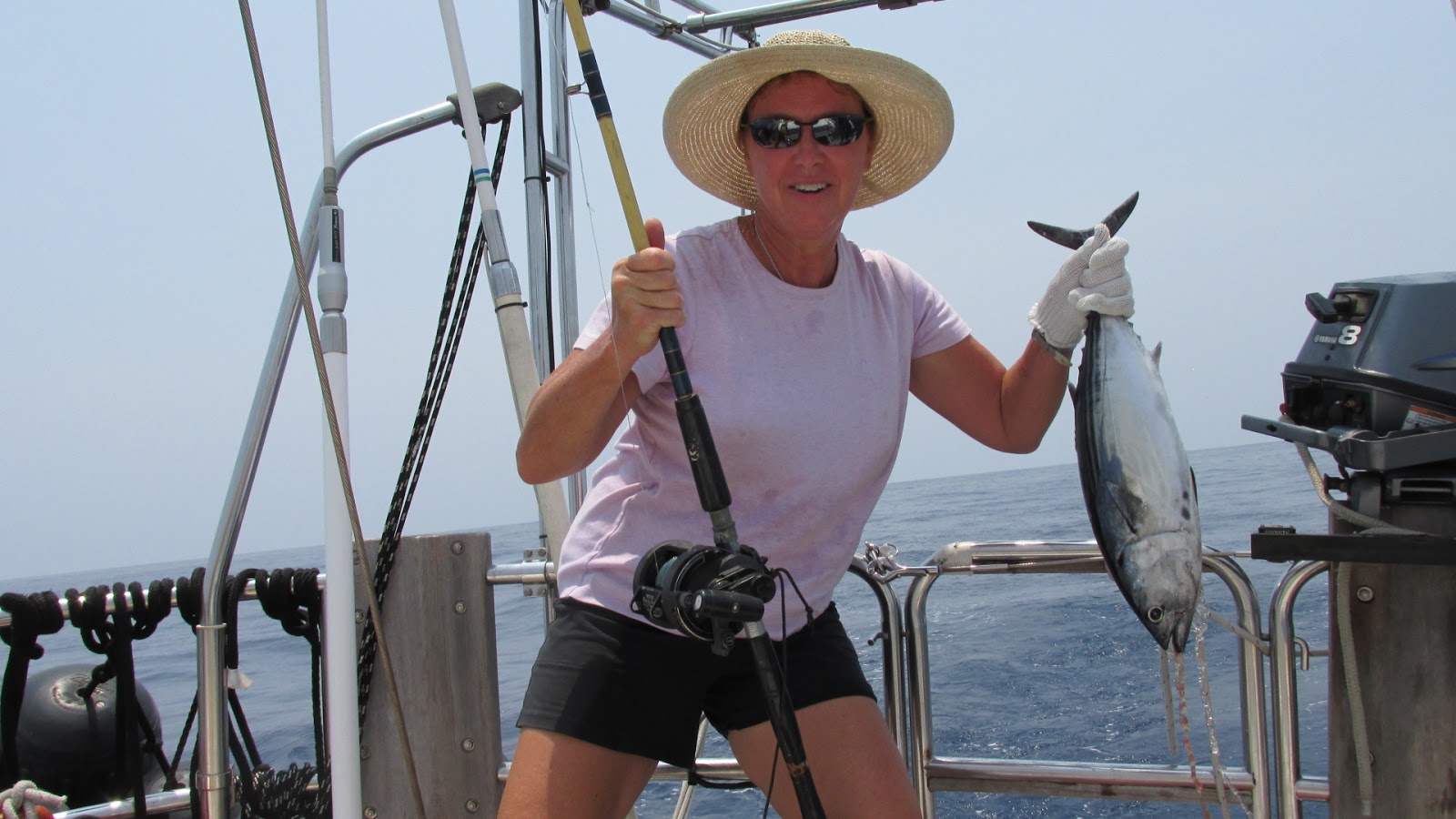
Shawna catches a Bonita

Chris chills after the Tehuantepeck crossing


The infamous Gulfo de Tehuantepeck was no big deal when we crossed in early May, although other times of the year the storms that brew here cause sailors to delay on both side for days or weeks while they wait for a weather window to avoid strong wind and steep waves. A narrow portion of land separates the Gulf of Mexico from the Pacific Ocean here. The wind flows from the Gulf side and blows strongly into the Pacific when weather systems are flowing that direction. Two mountain ranges meet with a lowland gap between, creating a funnel to accelerate the wind. The storms are nicknamed "T-Peckers" and are best given due respect.


The winds were on our tail for the first day and we had a great day of sailing and fishing. I caught a Pacific Bonita and got to try the offshore fishing pole we picked up in Acapulco. There was a waning moon  and calm seas that night. The second day found us motoring into the harbor after a 36 hour passage in late afternoon where we were greeted by Mexican marines and drug sniffing dogs. The marina at Chiapas is the last stop before exiting the country, so as a border marina it is very strict with inspections. All incoming and out going boats are subject to rigorous inspections for drugs and money.

The marina itself is not one you would want to enter at night or at low tide since there are dogleg turns and shallow channels to navigate before entering the marina proper. the first two docks have 50 amp service and the back docks have only 30 amps, so we relocated the next morning so we could easily run our AC onboard. The marina manager and staff are bilingual and most helpful. Upon arrival we decided to stay a week  and explore inland a bit. This is a perfect marina for hauling out and storing a boat on the hard since they have a large travel lift and secure yard, the best in this part of the world. While we were here they hauled out several boats including a Tayana 55 like ours. The rates are very reasonable for summer stay at $250/mo and we were tempted to leave our boat here for the duration of the rainy season, but in the end we decided to sail on to Nicaragua and Costa Rica with a possibility of sailing back here later in the season. We're just not ready to get off the boat yet!


Thursday, May 5, 2016

Sailing to Huatulco


Sailing SE from Acapulco LoWang took his turn at the helm while Chris and I handled the sails. We enjoyed some nice wind for a change and were flying all sails when we turned SE for Huatulco, our next stop 40 hours away.

Once we were 10 miles out to sea we turned SE onto our course heading and had the wind directly behind us, we put up the spinnaker for the first time in our journey!

Sirena's spinnaker flies proudly for the first time!

Alice Ridley Turtle floats past as we sail.


Arriving in Huatulco, we stayed at Marina Chahue, a small marina with lots of surge but good protection from the wind of the Golfo de Tehuantepec. There we met up with some old friends and made some new ones. The taxi ride to town was short and there were plenty of shopping opportunities along with nice restaurants around the town square. We spent several days here provisioning, enjoying the local fare, and awaiting a good weather window for travel across the notoriously windy Golfo de Tehuantepec.

Square at La Crucecita

Cathedral and town square

Seminar demonstrating native dies and wool used for textile making.

Theresa and Shawna visit the Mezcal shop. Did you know they make chocolate mescal??? Yum.
Local restaurants have excellent dishes featuring the mole so popular in this region.

Fresh herbs being sold at the square.

Church of La Crucecita, La Parroquia de Nuestra SeƱora de Guadalupe. 

Images on the church ceiling.


Vibrant colors of the church murals.